
The American Express® Gold Card is the highest-earning card on supermarkets and restaurants for households that actually use the credits, and a punishingly expensive paperweight for those that don't. At a $325 annual fee with up to $240/year in promotional credits, whether the card "pays for itself" comes down to a precise question: will you spend the credits on things you'd buy anyway?
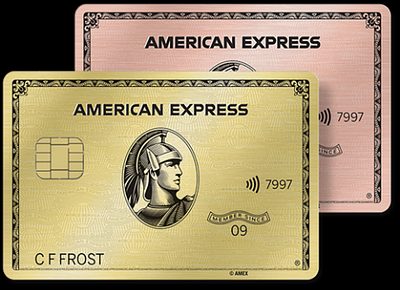
American Express® Gold Card
American Express Consumer Cards
How the rewards work
The Amex Gold earns Membership Rewards (MR) points across these categories:
- 4× at U.S. supermarkets, on up to $25,000/year in spend (then 1×)
- 4× at restaurants worldwide, including takeout and delivery in the U.S.
- 3× on flights booked directly with airlines or on amextravel.com
- 2× on prepaid hotels and other eligible travel booked through amextravel.com
- 1× on everything else
The 4× cap on supermarkets is the structural limitation: at $25k/year, you're earning 100,000 MR on groceries; spend above that drops to 1×. For a household spending $480/week ($25k/year) on groceries, this card is well-tuned. Above that, the Blue Cash Preferred's $6,000 cap on 6% supermarket cashback can't keep pace, but the unlimited 1× on the Gold means you'd want a different category card for the overflow.
What MR points are actually worth
Membership Rewards points have three valuation tiers:
- Statement credit: 0.6¢ per point. The worst possible redemption, avoid.
- Amex Travel portal: 1.0¢ per point on most bookings. Floor value, fine for occasional redemptions.
- 1:1 transfers to airline and hotel partners: typically 1.5–2.5¢ per point. This is where the math works.
Transfer partners include Delta SkyMiles, Air Canada Aeroplan, Air France/KLM Flying Blue, British Airways Avios, ANA, Cathay Pacific, Singapore KrisFlyer, Virgin Atlantic, Hilton Honors (1:2, low-value), and Marriott Bonvoy (1:1). The Aeroplan and Virgin Atlantic transfers consistently return 2¢+. Avoid statement credit redemptions, you're throwing away 40% of your points value.
Free Tool
Rewards Calculator
Enter your monthly spending by category and instantly see which cards earn you the most cash back or points.
Open Rewards CalculatorHow the statement credits affect the annual fee
The Gold's $325 fee is partly offset by promotional credits, but only if you genuinely use them:
- $120 dining credit: $10/month at Grubhub, Goldbelly, Cheesecake Factory, Wine.com, and Five Guys. Must use monthly, unused credits don't roll over.
- $120 Uber Cash: $10/month auto-loaded into your Uber/Uber Eats account. Non-rolling.
- $84 Dunkin' credit: $7/month at Dunkin' locations. Non-rolling.
- $100 Resy credit: $50 twice per year (Jan–Jun and Jul–Dec) at U.S. Resy restaurants. Non-rolling.
That's up to $424/year in stated credits, but only if you'd buy from each merchant anyway. The honest framing: if you don't currently order Grubhub or eat at Cheesecake Factory, the $120 dining credit isn't $120 of value, it's $0 (or worse, it pulls you into spending you wouldn't otherwise).
Realistic credit usage by household type:
- Urban renters who use Uber regularly: $120 Uber + $120 dining (Grubhub) = $240 used. Net cost: $85/year.
- Suburban families: $50–$80 of credits used (occasional Cheesecake Factory, no Uber). Net cost: ~$245/year.
- Coffee-shop heavy: Add $84 Dunkin' if it's on your route. Bumps urban household to $324 in credits, near-zero net fee.
Welcome offer & intro APR
The Gold typically offers 60,000 MR points after $6,000 spent in 6 months, occasionally bumped to 90,000 or 100,000 in elevated promos. At a conservative 1.7¢/point transferred, 60,000 MR ≈ $1,000 in award redemption value.
There is no 0% intro APR, Amex charity cards generally don't offer one. Full payment is expected. The Gold is technically a "charge card" historically (no preset spending limit, balance must be paid in full each month) although Amex now allows a "Pay Over Time" feature for some purchases.
Featured Offer
American Express® Gold Card
Hosted by American Express Consumer Cards
Key card details
| Annual Fee | $325 |
| Rewards Rate | N/A |
| Intro APR | N/A |
| Regular APR | See Pay Over Time APR |
| Credit Needed | Excellent, Good |
| Foreign Transaction Fee | 0% |
Travel and purchase protections
Protections are weaker than the Sapphire Preferred at this price point:
- Trip delay insurance: up to $300 per trip after a 12-hour delay (only on tickets fully paid with the card)
- Baggage insurance: up to $1,250 carry-on / $500 checked for lost or damaged bags
- Return protection: up to $300/item, $1,000/year on items the merchant won't take back within 90 days
- Purchase protection: 90 days against damage or theft, up to $10,000/claim
- Extended warranty: adds 1 year to U.S. manufacturer warranties of 5 years or less
No primary auto rental coverage and no trip cancellation insurance. If travel protections matter, the Sapphire Preferred ($95) actually outperforms the Gold ($325) in this category.
Annual fee math: when does $325 make sense?
Three break-even tests:
- If you'll use $200+ of the credits: The card competes directly with no-fee category cards. At $25,000/year supermarket spend (4× = 100,000 MR ≈ $1,700 transferred), you're earning $1,500+ above what a 2% flat-rate card would return. Even at $10,000/year supermarket + $5,000 dining, you're $400+ ahead.
- If you'll use only $80–$120 in credits: The fee net of credits is ~$200. Break-even is roughly $13,000 in 4× category spend (vs. a 2% flat-rate card). Realistic for many households.
- If you'll use almost none of the credits: The full $325 fee is a real cost. A no-fee 3× dining/grocery card (Capital One SavorOne) earns more after fees on most spending profiles. Don't get the Gold for FOMO.
Amex Gold vs. the alternatives
Amex Gold ($325) vs. Chase Sapphire Preferred ($95)
Gold earns more on groceries (4× capped at $25k vs. 3× online groceries only on Sapphire Preferred) and dining (4× vs. 3×). Sapphire Preferred earns more on flights through Chase Travel (5× vs. 3×) and has stronger trip protections. For grocery + dining-heavy spenders who eat out and use Uber: Gold. For travelers who book flights and want trip protection: Sapphire Preferred. Many people hold both.
Amex Gold ($325) vs. Blue Cash Preferred ($95)
Both target groceries. Blue Cash Preferred earns 6% at U.S. supermarkets capped at $6,000/year (then 1%), roughly $360 in cash back at the cap. Gold earns 4× MR on $25,000, roughly $1,700 in transferred value at the cap. The break-point: if your supermarket spend is under $6,000/year and you don't transfer points, Blue Cash Preferred is simpler and earns more. Above that, or if you'll transfer to airline partners, Gold is dramatically better.
Amex Gold ($325) vs. Capital One SavorOne ($0)
SavorOne is unlimited 3% on dining, entertainment, streaming, and grocery stores (excluding Walmart and Target). It earns less than the Gold's 4× on dining/groceries but has zero annual fee and no transfer requirement. For someone who won't optimize MR transfers and spends modestly on dining (under $5,000/year), SavorOne typically nets out ahead after fees.
Side-by-Side
Compare Dining Cards
See which cards earn the most on restaurants, takeout, and delivery.
Compare Dining CardsThe 90-day membership rewards point lock
If you cancel the Gold and don't have another Amex card with a Membership Rewards account, your points are forfeited 30 days after cancellation. Three options if you decide to drop the card:
- Transfer all points to an airline/hotel partner before cancellation
- Downgrade to a no-fee Amex (e.g., Blue Business Plus for personal use, or Cash Magnet) to keep the MR account alive
- Use up the points on travel before canceling
This trap catches people who get the welcome bonus, hate the fee, and cancel too quickly. If you're considering cancellation, plan the points exit at least 60 days in advance.
The Amex once-in-a-lifetime bonus rule
American Express welcome bonuses are once per product, ever. If you've held the Gold (or its predecessor, the Premier Rewards Gold) before, you almost certainly cannot earn the welcome bonus again. There's no public "wait 24 months" workaround like the Chase 48-month rule. Amex tracks bonus eligibility forever, and the application page warns you in fine print before submission.
Who this card is for
- Households spending $5,000+/year at U.S. supermarkets and $4,000+/year on dining
- Anyone who already uses Uber, Grubhub, or eats at Cheesecake Factory regularly (the credits become real)
- People willing to transfer Membership Rewards to airline partners, which is where the math works
- Foodies who travel and want a card that rewards both
Who should look elsewhere
- You won't use the credits or transfer points; choose a no-fee category card or 2% flat-rate cash back instead
- You spend mostly on rent, gas, or warehouse clubs (no category bonus on this card)
- You want trip protection insurance (Sapphire Preferred is better at $230 less)
- You've held the Gold before and aren't eligible for the welcome bonus
Our verdict
The Amex Gold is the highest-earning grocery and dining card on the market, but only if you use the credits and transfer points strategically. The $325 fee is real money; the $240+ in credits are only "savings" if you'd spend them anyway. The honest test: list the merchants where the credits apply, then ask yourself whether you'll spend at each one this month and every month for a year. If the answer is yes for 60%+ of them, the card pays for itself many times over. If it's no, the Sapphire Preferred or a no-fee category card almost certainly nets you more after fees.
Featured Offer
American Express® Gold Card
Hosted by American Express Consumer Cards
Rates & fees apply. Terms apply to all benefits and credits. See the issuer's website for current terms and conditions.